Christopher HabetlerAcademic Health Coach, drawnBack to What I Build

Academic Health Coach

For principals. It talks you through your own data and the next move.

One closed spreadsheet, one exchange, three places to land, and the question that would change the answer A line drawing. Left of center, one small spreadsheet: a dense lattice of fine cells with short marks in many of them, a heavier header row, and a heavy frame that shuts it. Deep inside the lattice, one short heavy mark, plainly different from the rest and plainly out of reach. To its right, an exchange drawn as one continuous zigzag: a single line leaves the right side, runs left, turns back in a tight hairpin, runs right, turns again, eight traverses in all, each a different length, so the turns fall at different places across the span. At each turn of the zigzag the buried mark steps up through the lattice, by a different amount each time, until it rests just above the sheet’s top edge. From there one thin line rises over the exchange and runs right, and three thin routes leave it at three different points: a rising curve to two chairs facing each other, a long straight diagonal down to an open circular arrow with two small strokes inside it, and a bend down into a single small sheet with three list lines. Last, after the drawing is complete: the surfaced mark is circled, and a short line runs from the circle back down into the lattice to a second cell, which is drawn only as an empty ring.

Buried in a spreadsheet.

Ask before tell.

A conversation with one teacher

What to bring to Wednesday’s meeting

The 1:1 and the principal manager routine

Name the load-bearing data point and what would flip the call.

One closed spreadsheet, one exchange, three places to land, and the question that would change the answer A line drawing, stacked top to bottom. At the top, one small spreadsheet: a dense lattice of fine cells with short marks in many of them, a heavier header row, and a heavy frame that shuts it. Deep inside, one short heavy mark, plainly different and plainly out of reach. Below it, an exchange across the full width drawn as one continuous zigzag: a single line leaves the right side, runs left, turns back in a tight hairpin, runs right, turns again, eight traverses in all, each a different length, so the turns fall at different places across the width. At each turn of the zigzag the buried mark steps up through the lattice, by a different amount each time, until it rests just above the sheet’s top edge. From there one thin line runs right and down the right margin, and three thin routes leave it into the lower third: a long sweep left to two chairs facing each other, a bend into a single small sheet with three list lines, and a drop to an open circular arrow with two small strokes inside it. Last, after the drawing is complete: the surfaced mark is circled, and a short line runs from the circle back into the lattice to a second cell, drawn only as an empty ring.
  • Buried in a spreadsheet.

  • Ask before tell.

  • A conversation with one teacher

  • What to bring to Wednesday’s meeting

  • The 1:1 and the principal manager routine

  • Name the load-bearing data point and what would flip the call.

Academic Health Coach. What a principal needs to know, one question away. It asks before it tells, sends the call to the person who has to make it, and ends by naming what would change the answer.

One question, start to finish

A Monday morning in one grade’s math, from the numbers on the screen to a plan the assistant principal can run. Every teacher, student and number below is invented.

  1. Step 01

    What you start with

    Monday morning, week five of the quarter. The failure rate in one grade’s math has gone from nine percent to twenty-two, and almost all of it is in one second-year teacher’s three sections.

    The numbers are true and they do not tell you what to do. What you also know is not in the data: the unit test is built and keeps getting pushed, and your assistant principal has been coaching her on questioning since September.
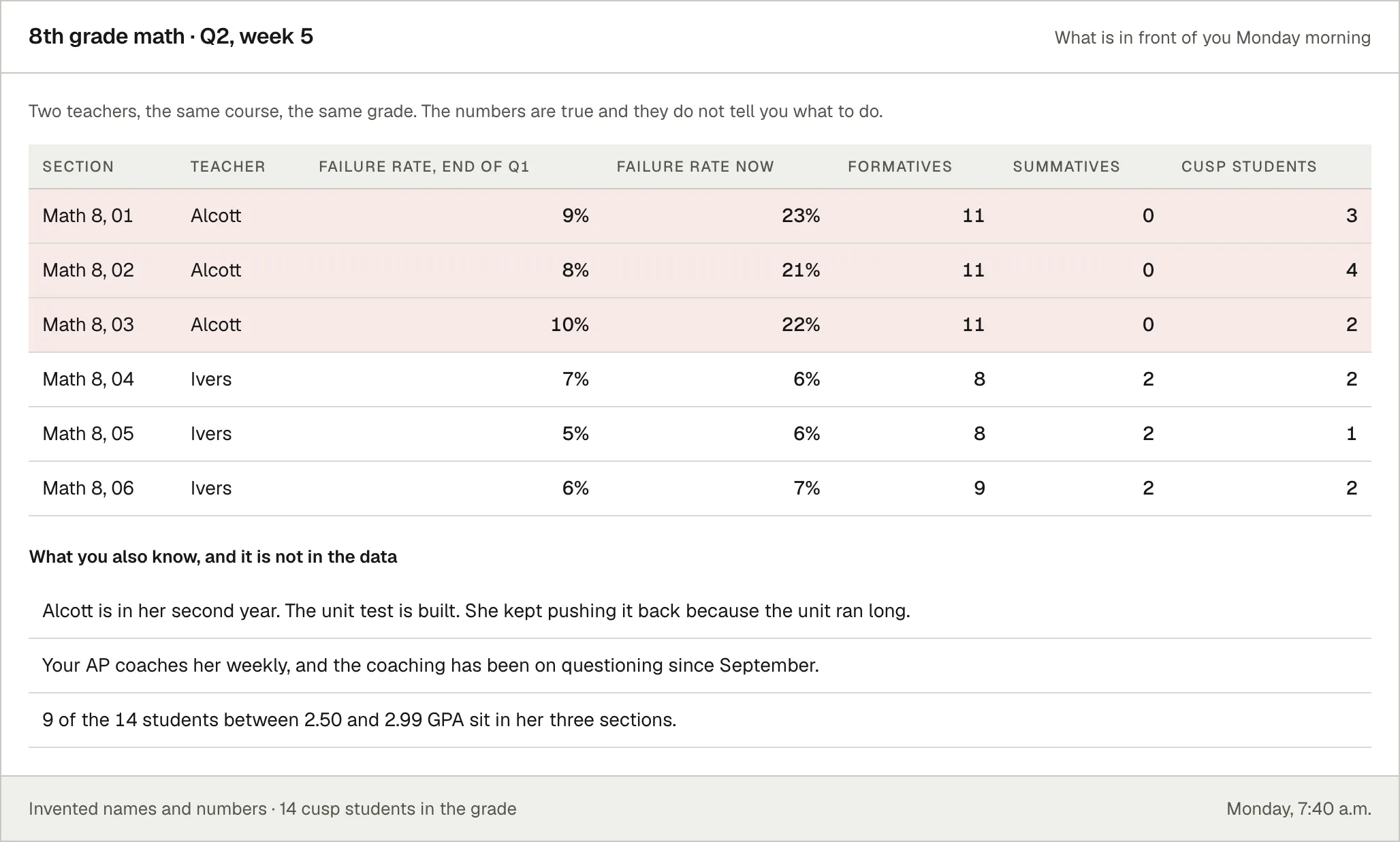
    An invented picture of one grade’s math. A table compares six sections across two teachers, showing the failure rate at the end of the first quarter against the rate now, how many formative and summative assignments are in each gradebook, and how many students are on the edge of a three point zero. Three sections are flagged red. Below the table, three things the principal knows that are not in the data.
  2. Step 02

    What you ask

    Paste in what your data shows, in your own words. No format, no upload, no student names. Then ask for what you actually want, which here is a one-week plan with owners.
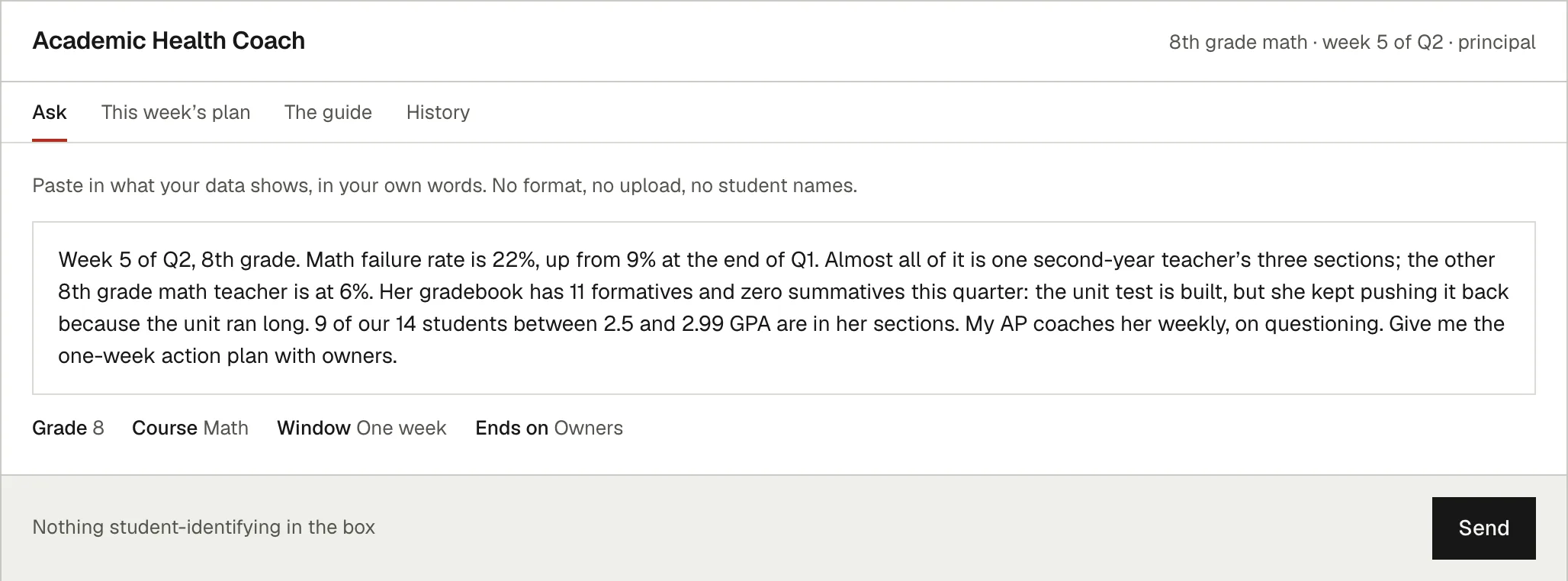
    The Ask screen of the Academic Health Coach with a paragraph typed into the box, describing an invented eighth grade math picture in plain sentences and ending with a request for a one-week action plan with owners. A row underneath shows the grade, the course, the window and what the answer should end on.
  3. Step 03

    What comes back

    It walks you through the read, then coaches the conversation you need to have, with one teacher, a grade-level team, or your own routine, and ends on a one-week action plan with owners.

    Then it asks you something back. What’s in there is the judgment I’d bring to that conversation. A principal gets the read in one question instead of digging for it in a spreadsheet.
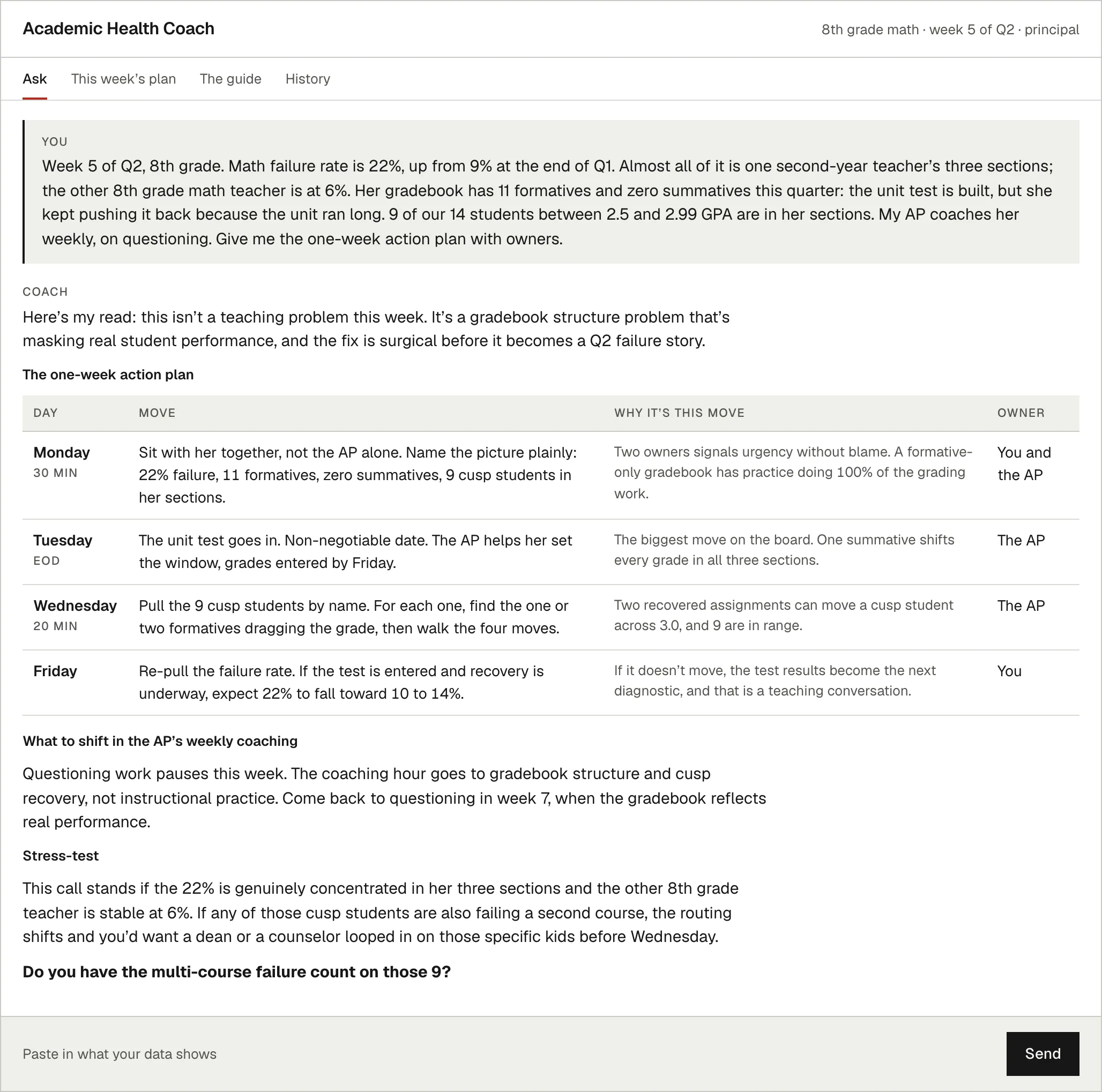
    The Academic Health Coach in the suite look. A principal pastes in an invented eighth grade math picture and asks for a one-week plan. The coach names the problem, then lays out a table of Monday through Friday moves with the reason for each and who owns it, and ends by asking one question back.
  4. Step 04

    What a person decides

    You answer its question, you keep what it got right, and you change what it got wrong. Here that’s one move added, because three of the nine students are failing a second course and that’s a counselor’s conversation, and one move pushed to Thursday because you know what Wednesday looks like.

    Then it goes to the assistant principal as a plan with five moves and two owners, and one of them is you.
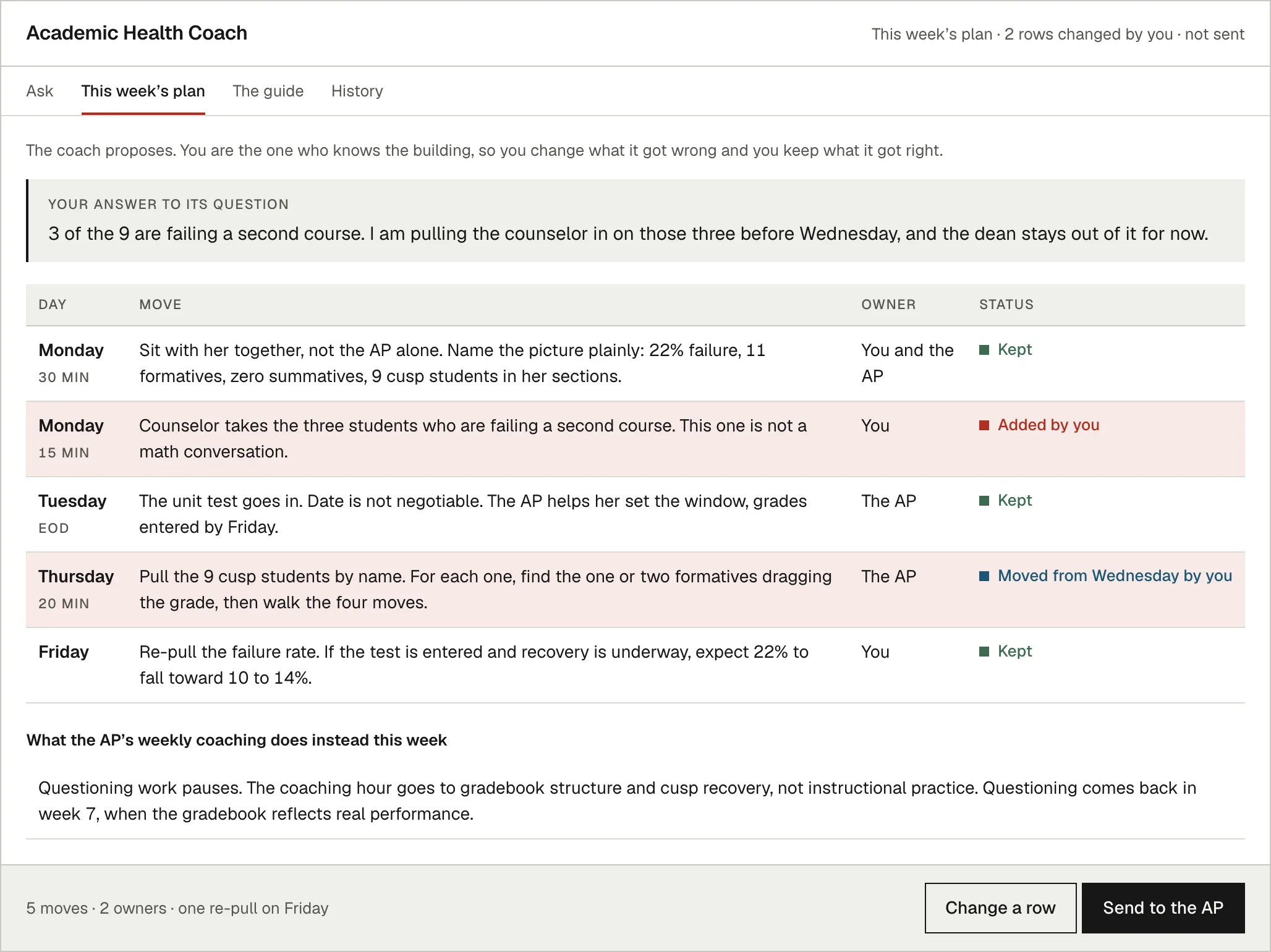
    This week’s plan after the principal has edited it. Their answer to the coach’s question sits at the top. A table lists five moves by day with the owner and a status on each: three kept, one added by the principal, one moved to a different day. Under it, the one line describing what the assistant principal’s weekly coaching does instead this week.

How long it takes

Four steps: look at the numbers, say what you see, read what comes back, change what it got wrong. There is no upload, no setup and nothing to learn, because the whole interface is a box you type into.

It replaces the version where the read stays buried and the plan gets written on the way to the meeting.

This one is live, and it’s free. Open it, break it, and tell me what it got wrong.

Book a 30 minute call (opens in a new tab)The coach is free to try: open the app (opens in a new tab). Or write me at chris@habetlerconsulting.com.